Shelter & camp
Tarp geometry, tarp sizes, guyline lengths, pitching for wind and choosing a campsite, worked through with formulas and the Shelter studio.
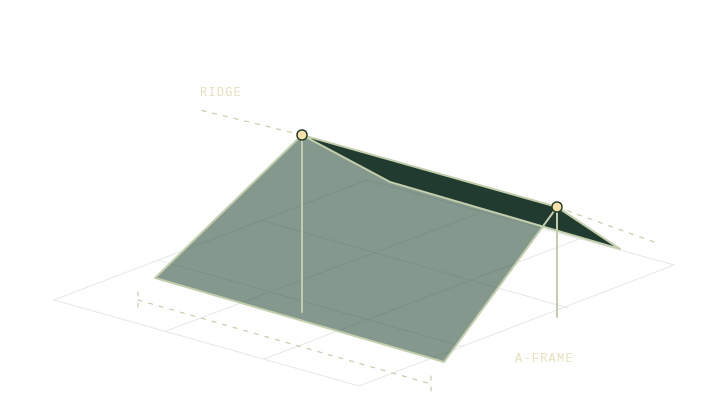
Most tarp questions are geometry in disguise: how high, how wide, how much cord. These guides work them through with the same equations as the Shelter studio, then mark where geometry stops and weather, ground and judgement take over.
- 016 min read
A-frame tarp geometry: what ridge height really buys you
Work out A-frame tarp floor width, wall angle and usable headroom from ridge height, with a table for a 3 m tarp and the formulas behind it.
- 026 min read
What size tarp do you need for camping?
Choose tarp size for camping: floor width, wall angle, sleeping length and fabric area for 2×3, 3×3 and 3×4 m tarps, with the arithmetic shown.
- 035 min read
How much guyline does a tarp need? End guys and ridgelines worked out
Work out tarp guyline length from ridge height and stake distance, then add a ridgeline allowance for tree spacing, trunk wraps and knots.
- 046 min read
How to pitch a tarp for wind: ridge height, orientation and tension
Pitch a tarp for wind by lowering the ridge, turning an open end away from the wind and keeping guylines tight, with the cost in headroom.
- 057 min read
Choosing a campsite: overhead hazards, ground and where the sun comes up
How to choose a campsite: check rules, overhead hazards, drainage and sleeping ground, then use sunrise bearing to place the open end of a tarp.
- 063 min read
Raise the tarp ridge and watch the floor narrow
Compare two A-frame ridge heights on the same tarp. Work out how much usable ground width moves inward and how to check it before a trip.
- 073 min read
Check tarp clearance at mat and sleeping bag height
Estimate the width under an A-frame tarp at a chosen height, then use Shelter Studio and a measured test pitch to check your sleeping space.
- 083 min read
Record both ends of the tarp ridge
Write a two-ended true bearing for an A-frame ridge, compare it with the forecast wind direction and use the result to discuss your pitch.